
The Glyphosate E.O.
The Moment of Reckoning America Cannot Avoid
The Executive Order signed this week regarding glyphosate has stirred deep concern among Americans who had rallied behind Trump’s plan to “drain the swamp.” The Administration seemed to be moving the country toward restored health. The MAHA Movement, in particular, assumed the health of our nation would include an immediate separation from the chemical soup that is unfortunately found in our food.
But then, this EO appeared out of nowhere, tying glyphosate to national defense?
For those who have spent years dealing with a chronic illness from an environmental exposure, this question feels unavoidable: Why would an Administration that was beginning to recognize, on a large scale, the biological consequences of environmental toxins, take steps to secure the continued supply of one of the most widely used, poisonous herbicides in history?
More than Policy
The answer reveals something far more significant than a policy decision. It reveals how thoroughly our modern food system has been built around assumptions that few people were ever invited to question.
Glyphosate became central to agriculture because farming was gradually redesigned to accept it. Certain major crops, especially soy and corn, were genetically modified to survive direct exposure to the chemical. This allowed farmers to easily manage weeds, dramatically increase production, and reshape their expectations.
What began in the 1970s as a technological breakthrough in weed control gradually became a pillar of modern agriculture. When Monsanto introduced Roundup, an herbicide with glyphosate as its active ingredient, it was promoted as an efficient, broad-spectrum herbicide that simplified farming and improved yields. Over time, especially with the expansion of Roundup Ready crops, its use became routine. Farmers built entire crop systems around glyphosate-tolerant seeds, no-till practices, and even pre-harvest desiccation. What was once an innovation became embedded as essential for American food production.

At the same time, global manufacturing patterns shifted. As production costs and regulatory pressures increased domestically, much of the chemical manufacturing supply chain moved overseas to China. In fact, estimates indicate that Chinese manufacturers account for roughly 60–70 % of the world’s total glyphosate. The result is a strategic imbalance: the United States relies heavily on China for a chemical deemed “essential” to America’s modern agriculture. This potentially creates supply chain vulnerabilities, economic exposure, and even national security concerns.
The recent Executive Order must be viewed in the context of how deeply glyphosate is embedded in America’s agricultural system. It did not address the health concerns associated with glyphosate exposure, nor did it attempt to resolve the scientific debates regarding its long-term biological effects.
Instead, it acknowledged a practical reality: the modern food production system relies heavily on this chemical, some would say far too heavily. For many, that recognition caused deep-seated frustration. Public awareness of glyphosate’s impact on health has grown far more quickly, thanks to groups such as Moms Across America, than the agricultural system can change.
Health Issues from Glyphosate are Real
A growing body of research and clinical observation has raised serious concerns about glyphosate’s biological effects. Studies have shown it disrupts the gut microbiome by altering beneficial bacterial populations. Glyphosate has been shown to interfere with endocrine signaling, impair mitochondrial function, contribute to immune dysregulation, and increase cancer risk. When viewed collectively, these mechanisms point toward chronic, system-wide stress. For clinicians and researchers, continued large-scale exposure to this poison becomes increasingly difficult to defend.
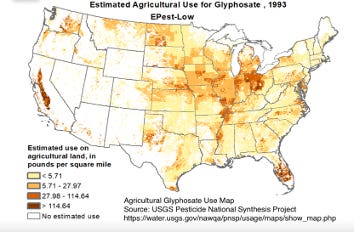
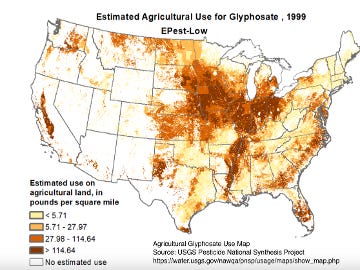
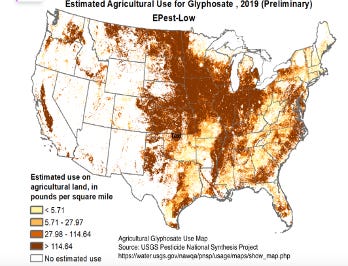
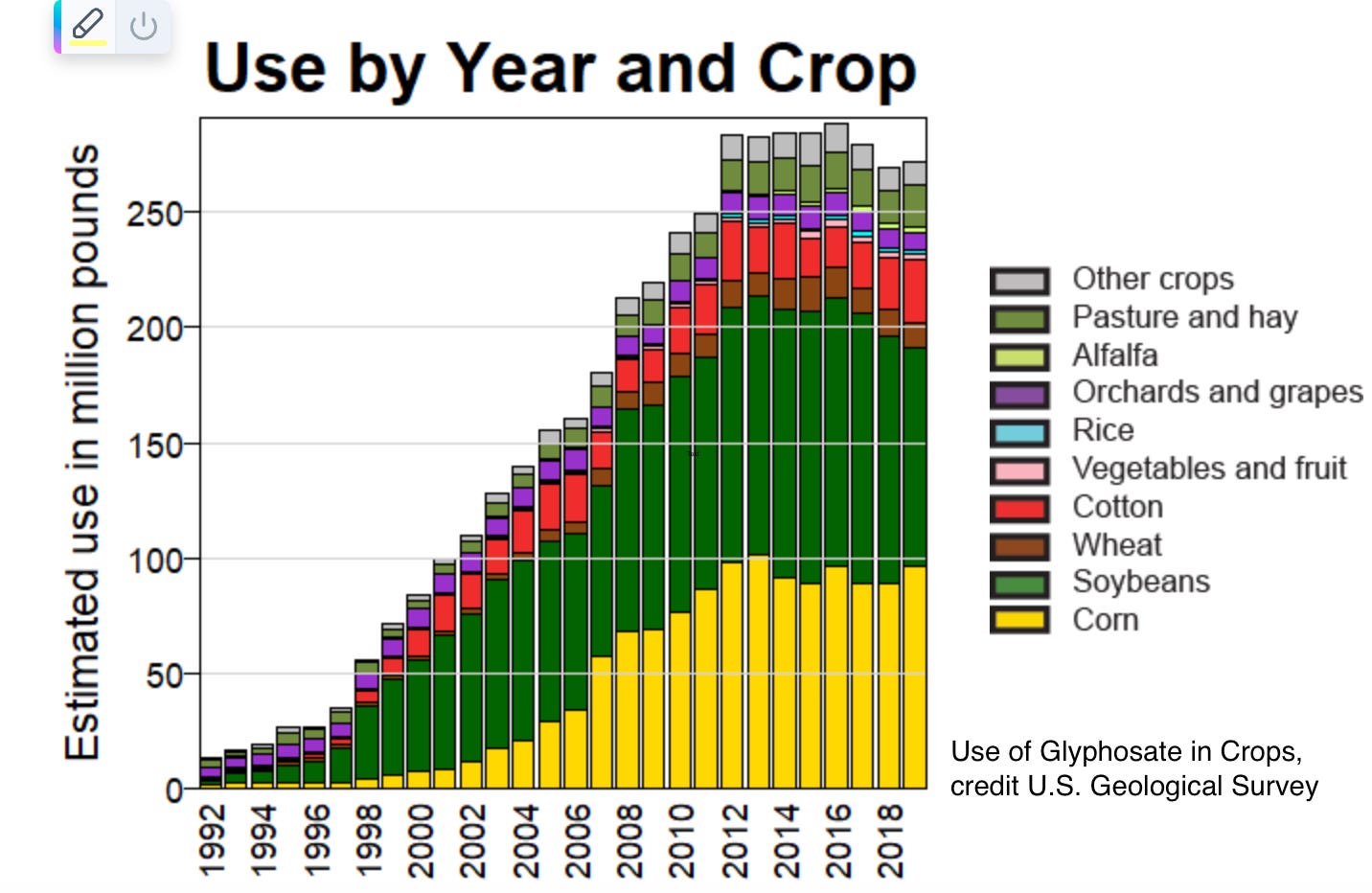
Yet, look how glyphosate usage has expanded over the years. These graphics are from the US Geological Survey’s Pesticide National Synthesis Project. They document the estimated annual agricultural pesticide use across the US over the last 30 years, from 1993 to 2023.
And this is glyphosate in our food
NEXT WEEK’S PODCAST LINE-UP. Click here
Why Not Just stop?
Modern agriculture was built on the premise that glyphosate was both safe and essential. Farmers adopted herbicide-tolerant crops, invested in specialized (GMO) seed technologies and application equipment, and entered supply contracts structured around their routine use. Entire supply chains evolved on the assumption that this chemical would remain a permanent fixture in food production. That dependence is now in a face-off with the voluminous amount of evidence questioning its safety and impacts on health.
Simply removing or replacing glyphosate is not a simple switch. Any meaningful change would require embracing and full implementation of alternative farming methods, regenerating the toxic soil, returning to non-GMO crops, and economic stability — while reducing chemical exposures that may contribute to chronic disease. The challenge is not only to identify harms to health, but also to redesign food production.
The Executive Order exposed our national dependence on glyphosate. Once that dependence became visible, it cannot be ignored. This moment adds to the growing public awareness of what’s happening to our food. People no longer trust Big Ag and Big Food. When informed citizens, farmers, and consumers begin to challenge political decisions, they also start to ask serious questions about what is at stake.
The Great Awakening has begun nationwide and we need to keep the pressure on. Let them know we are watching.

It’s a decision farmers need to make from now on. Ethical farming should also be priority here. When farmers stop buying into the BS propaganda, the BS stops. Let’s focus on ethical farmers. We need to start making changes ourselves because the government won’t.
Hi Sherri: While it is certainly true that one cannot merely flip a switch on glyphosate production, it is also true that domesticating production will cost tens of millions of capital from either the government or the private sector or both. It is also true that once that capital is allocated, especially if by the government, glyphosate will become a permanent fixture in American agriculture. No one will be able to ban the substance - not Bobby and not anyone else. In effect, domesticating production is a subsidy from the government to a broken business model - the dependence on chemical “additives” in farming. The dependence on the government to sustain a broken business model is not something we should ever pursue. It is the agricultural equivalent of allowing banks to engage in risk behavior knowing that the government will bail them out if they do something stupid - THINK 2008. From a finance perspective - it is more than dumb - it is stupid. Especially when considering that the taxpayer subsidy is used to sustain something that causes such harm and downstream liabilities. Even more than that, the subsidy does nothing for organic farmers or small family farms who are already interested in regenerative agriculture because it is superior to preserving their asset (SOIL) and generates more cash flow. So, only the large industrial farming operations are really subsidized here and they sell the most poisonous food. The fact that China now makes most of this stuff is all the incentive needed to alert large commercial operations that market forces are going to be allowed to work. The government will not support your business model. They have plenty of time to convert their operations from one that creates unfunded liabilities downstream to one that requires no government subsidy. We should be telling them - Shift your model or go bankrupt. That is the way the market forces work. The President’s EO is nothing more than evidence of the old adage - Socialize Risk and Privatize Profits. It is, economically speaking just like the old CDC vaccine schedule. To use a technical term - built on bullshit. As for me, I say the sooner we allow the existing model to blow up, the better. Those producers too lazy or too stupid should be allowed to fall.